Turn signals are one of the most important safety systems on a motorcycle. Whether you are building a Cafe Racer, Bobber, Scrambler, or simply replacing your original indicators with LED turn signals, electrical problems can sometimes occur after installation.
A turn signal system usually consists of several components, including the turn signal switch, turn signal relay, wiring, connectors, fuse, and front/rear turn signal lights. When one part has a problem, the entire system may behave unexpectedly.
This guide explains the most common motorcycle turn signal problems, their possible causes, and practical troubleshooting methods.
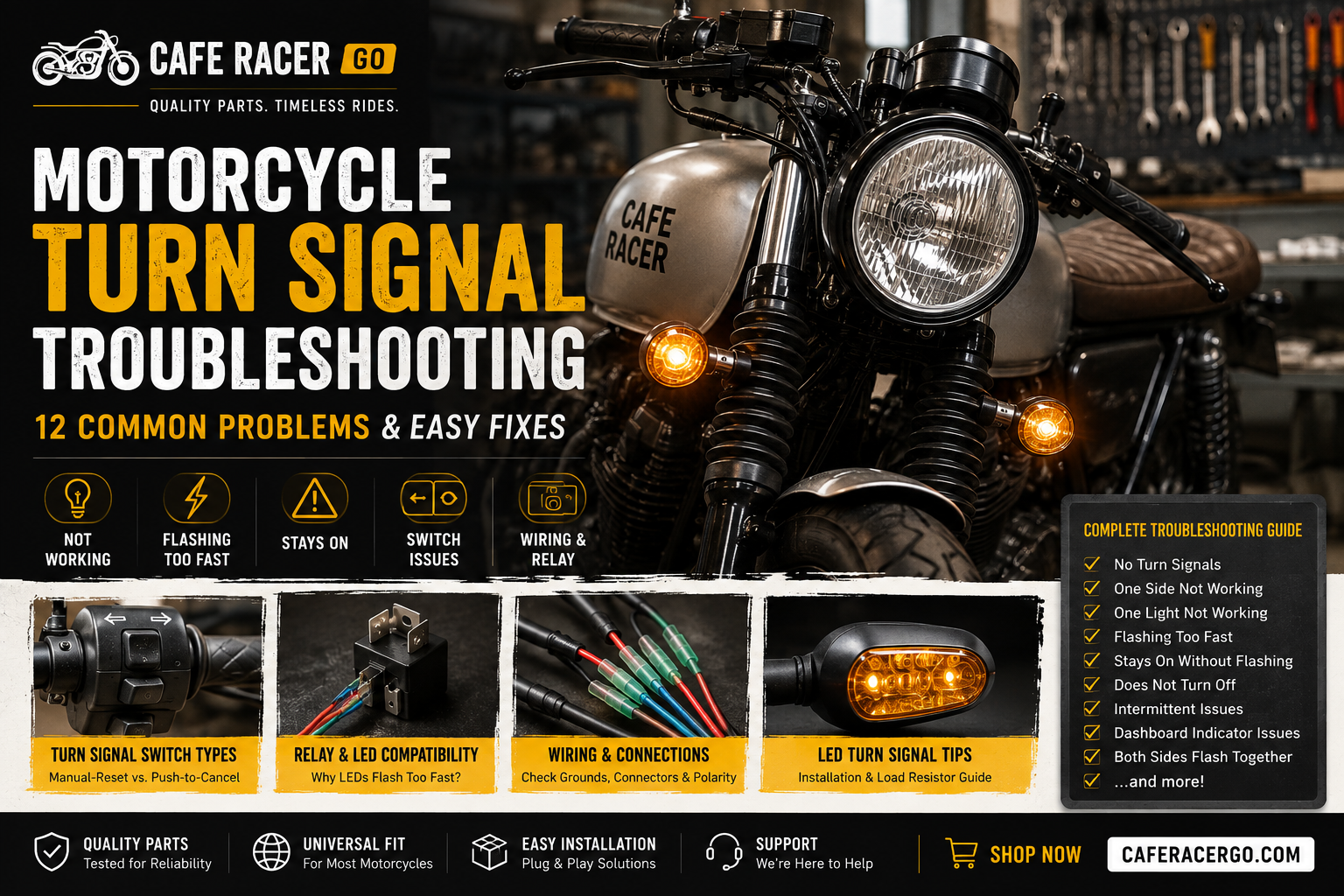
I. How Does a Motorcycle Turn Signal System Work?
Before troubleshooting, it helps to understand the basic circuit.
A typical motorcycle turn signal system works roughly like this:
Battery → Fuse → Turn Signal Relay → Turn Signal Switch → Left/Right Turn Signals → Ground
The turn signal switch determines which side receives power.
There are two common switch designs:
Manual-Reset Turn Signal Switch
The switch is moved left or right to activate the corresponding turn signal and must be manually returned to the center position to cancel it.
Push-to-Cancel Turn Signal Switch
The switch is moved left or right to activate the turn signal. Pressing the switch cancels the signal and returns it to the center position.
When replacing a switch on a Cafe Racer or custom motorcycle, make sure the replacement switch has the correct electrical configuration and matches the original wiring.
II. Common Motorcycle Turn Signal Problems
1. Turn Signals Do Not Work at All
If neither the left nor right turn signal works, check the system from the power source toward the lights.
Possible Causes
- Blown fuse
- Faulty turn signal relay
- Loose or disconnected wiring
- Poor ground connection
- Faulty turn signal switch
- Battery voltage too low
- Damaged connectors
Troubleshooting
Start by checking the fuse and battery voltage.
Then inspect the wiring around the handlebar and headlight area. This is especially important on Cafe Racer builds, where the original wiring harness may have been shortened, rerouted, or modified.
If power reaches the turn signal switch but neither side receives output, the switch may be faulty or incorrectly wired.
III. One Side Does Not Work
If the left turn signals work normally but the right side does not, or vice versa, the problem is usually localized to that circuit.
Check:
- Turn signal switch
- Wiring
- Connectors
- Front turn signal
- Rear turn signal
- Ground connection
A loose connector or broken wire can easily cause one side to stop working.
For custom motorcycle builds, pay particular attention to wires routed inside or around the handlebar. Repeated handlebar movement can eventually damage poorly secured wiring.
IV. One Turn Signal Light Does Not Work
If only one individual indicator is not working, the problem is usually closer to the light itself.
Check the Following:
- LED indicator polarity
- Ground connection
- Loose connector
- Damaged wire
- Faulty LED
- Incorrect wiring
LED turn signals are polarity-sensitive.
If the positive and negative wires are reversed, the LED may not illuminate.
For a newly installed LED turn signal, checking polarity should be one of the first troubleshooting steps.
V. Turn Signals Flash Too Fast
This is one of the most common problems when upgrading a motorcycle from conventional bulbs to LED indicators.
The motorcycle may suddenly develop:
Fast flashing / Hyper flashing
Why Does This Happen?
Traditional incandescent bulbs usually have a higher electrical load than LED turn signals.
When LEDs are installed, the lower current consumption can cause the original turn signal relay to interpret the reduced load as a failed bulb.
Possible Solutions
Option 1 — Install an LED-Compatible Relay
This is usually the cleaner solution for a custom motorcycle.
Option 2 — Install Load Resistors
A load resistor increases the electrical load seen by the original relay.
However, resistors generate heat and must be installed correctly.
For most Cafe Racer LED conversions, an appropriate LED-compatible relay is often preferable to adding resistors.
VI. Turn Signals Stay On Without Flashing
If the indicator illuminates but does not flash, check the following:
- Turn signal relay
- Relay wiring
- LED compatibility
- Power supply
- Ground connection
A faulty or incompatible relay is one of the most common causes.
If the motorcycle has been converted from incandescent bulbs to LED turn signals, make sure the relay is designed for the electrical load of LED indicators.
VII. Turn Signal Does Not Turn Off
This problem is particularly important when replacing the turn signal switch.
If the turn signal remains active after installation, check whether the motorcycle uses:
Manual-Reset Switch
The switch must physically return to the center position.
Push-to-Cancel Switch
The switch must be pressed to cancel the signal.
If a replacement switch has a different operating mechanism or internal contact arrangement from the original switch, the wiring may not work correctly even if the switch physically fits the handlebar.
Therefore, mechanical compatibility and electrical compatibility are both important.
VIII. Turn Signal Switch Works on One Side Only
For example:
- Left = Works
- Right = Does not work
Possible causes include:
- Incorrect wire connection
- Damaged switch contact
- Broken right-side signal wire
- Loose terminal
- Incorrect replacement switch
- Internal switch failure
When installing a universal motorcycle switch, do not rely only on wire colors.
Wire colors are not universal across all motorcycle manufacturers.
Always identify the switch terminals using the wiring diagram or a multimeter.
IX. Turn Signals Work but the Indicator on the Dashboard Does Not
Sometimes the external turn signals work normally, but the dashboard indicator does not.
Possible causes include:
- Faulty dashboard indicator bulb/LED
- Incorrect wiring
- Poor ground
- Compatibility issue with LED indicators
- Modified wiring harness
On heavily customized Cafe Racer motorcycles, the original instrument cluster is often replaced with a minimalist speedometer or digital gauge.
When installing a new gauge, make sure the turn signal indicator wiring is compatible with the motorcycle's electrical system.
X. Turn Signals Work Intermittently
If the indicators work sometimes and stop working at other times, look for a poor electrical connection.
Common causes include:
- Loose terminals
- Corroded connectors
- Broken internal wires
- Poor ground
- Damaged switch contacts
- Loose fuse
- Vibration
Motorcycles experience considerable vibration, especially custom builds with modified frames, handlebars, and wiring.
A connection that appears acceptable when stationary may fail while riding.
Quick Test
With the motorcycle safely parked:
- Activate the turn signal.
- Gently move the wiring and connectors.
- Move the handlebar from left to right.
- Observe whether the light flickers or stops.
If the signal changes when the wiring moves, inspect that section carefully.
XI. Both Turn Signals Come On Together
If the left and right indicators illuminate simultaneously, there may be an incorrect connection between the left and right signal circuits.
Possible causes:
- Incorrect switch wiring
- Short circuit
- Incorrect dashboard indicator wiring
- Incorrect diode arrangement
- Incorrect aftermarket switch
This problem is particularly common when installing universal motorcycle handlebar switches without confirming the internal terminal configuration.
A multimeter can help identify which terminals are connected in each switch position.
XII. A Simple Motorcycle Turn Signal Troubleshooting Table
| Problem |
Possible Cause |
Recommended Check |
| No turn signals |
Fuse, relay, power or switch |
Check power and fuse |
| One side doesn't work |
Wiring or switch |
Check left/right circuit |
| One light doesn't work |
LED, polarity or ground |
Check connections |
| Flashing too fast |
LED load too low |
Check relay compatibility |
| Stays on without flashing |
Relay problem |
Test/replace relay |
| Does not turn off |
Switch or wiring |
Check switch type |
| Works intermittently |
Loose connection |
Inspect connectors |
| Both sides flash together |
Incorrect wiring |
Check switch terminals |
| Dashboard indicator doesn't work |
Gauge wiring |
Check indicator circuit |
XIII. Troubleshooting a Cafe Racer Turn Signal Installation
A Cafe Racer conversion often involves replacing the original indicators and handlebar controls with smaller aftermarket components.
This creates several potential electrical issues.
Before installing a new turn signal switch or LED indicators, confirm:
Electrical Compatibility
- System voltage
- Relay type
- LED compatibility
- Current requirements
- Ground connection
Mechanical Compatibility
- Handlebar diameter
- Switch mounting position
- Cable routing
- Lever/control clearance
For example, many aftermarket motorcycle switches are designed for 22 mm (7/8") handlebars, but the electrical terminal arrangement can vary significantly between products.
Therefore, a switch that physically fits your handlebar may not necessarily be electrically compatible with your motorcycle.
XIV. How to Test a Turn Signal Switch with a Multimeter
If you suspect the switch is faulty, a multimeter can help identify the problem.
Set the multimeter to continuity mode.
Then test the terminals in different switch positions.
Manual-Reset Switch
Check which terminals connect when the switch is:
Push-to-Cancel Switch
In addition to checking the left and right positions, test the switch while pressing the cancel button.
The exact terminal configuration varies between switch designs, so do not assume that two switches with the same number of wires have the same wiring configuration.
XV. Final Checklist Before Replacing Parts
Before purchasing a new relay or turn signal switch, check the following:
- Is the battery voltage normal?
- Is the fuse intact?
- Are both grounds secure?
- Are the connectors tight?
- Are the LED indicators wired with correct polarity?
- Is the turn signal relay LED-compatible?
- Does the switch match the original electrical configuration?
- Is the handlebar diameter compatible?
- Are the left and right signal circuits correctly connected?
Following these checks can often identify the problem without replacing multiple parts unnecessarily.
Conclusion
Motorcycle turn signal problems are often caused by relatively simple issues such as loose wiring, poor grounding, incorrect polarity, incompatible relays, or an incorrectly wired turn signal switch.
For Cafe Racer and custom motorcycle projects, electrical troubleshooting becomes especially important because the original wiring and controls are frequently modified.
When upgrading to aftermarket LED indicators or a universal handlebar switch, always check both mechanical fitment and electrical compatibility before installation.
A systematic troubleshooting process can save time, prevent unnecessary parts replacement, and help ensure that your motorcycle's turn signals work reliably and safely.


